You've probably looked around a school gym, church fellowship hall, community center, or large event space and wondered, "Can you use a bounce house indoors?" It's a common question for parents, schools, churches, businesses, and event organizers, especially during winter, rainy seasons, holidays, or when unpredictable weather threatens outdoor plans.
The short answer is yes—but only under the right conditions.
Indoor bounce houses can provide outstanding children's entertainment while protecting your event from rain, strong winds, extreme heat, or wintry weather. However, indoor bounce house use introduces a different set of safety considerations, including ceiling height, available floor space, ventilation, electrical requirements, venue policies, and proper supervision.
Simply having enough room isn't enough. The inflatable must be appropriate for indoor use, set up according to the manufacturer's instructions, and operated in accordance with proper bounce house safety guidelines. Building owners may also require liability insurance, rental agreements, fire codes, or safety inspections before approving an inflatable.
This guide explains when indoor bounce houses make sense, which safety standards should always be followed, how to choose an appropriate indoor space, and when it's smarter to choose another form of entertainment.
When Does Using a Bounce House Indoors Actually Make Sense?
In the simplest terms, an indoor bounce house works best when the inflatable is approved for indoor use, and the venue has enough space for a safe setup.
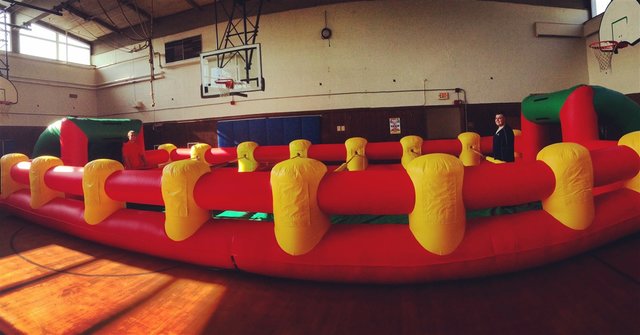
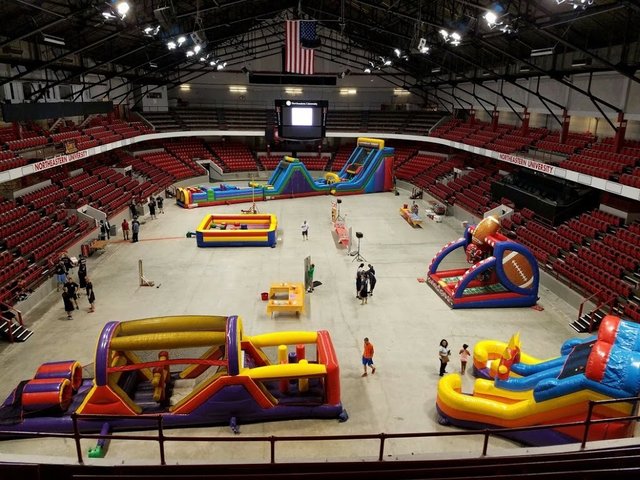
Large gyms, recreation centers, auditoriums, event halls, churches, and similar open facilities often provide the best environments because they offer generous floor space, high ceilings, and clear emergency exits.
On the other hand, many residential spaces, including garages, finished basements, living rooms, and playrooms, simply aren't designed for large inflatables, even if they initially appear spacious.
Before planning an indoor installation, confirm several important details:
- The inflatable is approved by the manufacturer or rental company for indoor use.
- The venue permits inflatable attractions.
- Ceiling height provides adequate clearance.
- There is sufficient open floor space around every side of the inflatable.
- Electrical service meets the blower's power requirements.
- Adult supervision can be maintained throughout the event.
Indoor bounce houses become especially popular for:
- Birthday parties
- School events
- Church activities
- Community celebrations
- Holiday parties
- Corporate family events
- Winter celebrations
- Indoor carnivals and festivals
The biggest advantage is obvious: you remove many weather-related concerns. Instead of watching the forecast every hour, families set up the inflatable and just enjoy uninterrupted entertainment in a controlled environment.
Even so, indoor events require their own planning.
What Types of Indoor Spaces Usually Work Best?
Not every indoor room should house an inflatable.
Large open facilities generally provide the safest environment because they allow installers to maintain proper clearance while keeping entrances, exits, and emergency pathways open.
Indoor spaces that often work well include:
|
Indoor Space |
Usually Suitable? |
Important Considerations |
|
School gymnasiums |
Often |
Ceiling height, power, floor protection, exits |
|
Recreation centers |
Often |
Capacity, ventilation, setup area |
|
Church fellowship halls |
Often |
Ceiling clearance, furniture layout |
|
Community centers |
Often |
Fire safety requirements, floor protection |
|
Auditoriums |
Sometimes |
Stage access, seating, exits |
|
Event halls |
Sometimes |
Columns, chandeliers, and available space |
|
Large commercial buildings |
Sometimes |
Venue approval and safety policies |
|
Garages |
Rarely |
Ceiling height, ventilation, and power availability |
|
Playrooms |
Rarely |
Furniture, limited clearance |
|
Living rooms |
Almost never |
Ceiling height, available space, obstacles |
The most important factor isn't simply room size, but usable space.
Furniture, support columns, built-in stages, storage areas, steps, ramps, decorative fixtures, and other permanent features reduce the amount of safe installation space available.
If you're unsure whether a room is suitable, provide your rental company with room dimensions and photographs before reserving the inflatable. Our team can help determine whether the space can safely accommodate a particular unit and help with choosing the right inflatable for your event based on the available space, ceiling clearance, and setup requirements.
How Do Indoor Bounce Houses Change Comfort, Noise, and Supervision?
Moving an inflatable indoors changes the location but also how the event feels.
And we mean that literally, not just in terms of "vibes".
It Can Get Noisy and Warm; Fast
You feel a difference indoors right away because, unlike outdoor parties where sound naturally dissipates, indoor spaces trap noise.
Children laughing, jumping, and playing combine with the continuous sound of the blower, creating a noticeably louder environment.
Indoor conditions also affect comfort.
Without adequate ventilation or air conditioning, rooms can warm quickly as children remain active, which is particularly important to consider for indoor events during winter, where the ventilation system will try to keep the indoor environment warm.
Before the event, consider:
- Is the room properly ventilated?
- Will the blower restrict airflow?
- Can windows safely remain open if needed?
- Does the building's HVAC system comfortably handle large groups?
- Will nearby rooms be affected by noise?
These questions become especially important for schools, churches, businesses, and community centers where multiple activities may occur simultaneously.
Parents should also consider children who may become overwhelmed by louder indoor environments.
Sometimes outdoor events actually create a calmer experience despite changing weather.
Active Adult Supervision Is Still Essential
One misconception is that indoor bounce houses require less supervision because they're inside a building.
The opposite is often true.
One responsible adult should remain assigned to the inflatable throughout the operation.
Their responsibilities include:
- Monitoring occupancy and capacity limits.
- Watching children enter and exit.
- Enforcing bounce house safety rules.
- Preventing flips, wrestling, and rough play.
- Ensuring shoes, jewelry, and sharp objects remain outside the inflatable.
- Monitoring younger children around older kids.
- Keeping entrances and exits clear.
For larger events, assigning multiple trained staff members or rotating volunteers helps maintain consistent supervision throughout the day.
Simply checking occasionally from another room isn't enough.